
St. Mary Anne’s History
In 1706, the colonial legislature and Maryland’s governor established the North Elk Parish on the north bank of the Elk River.
Henry Harford was Lord of the Manor on which the parish was to be located. He set aside four acres of land to establish the church buildings. (Local gossip from the time: Henry Harford was the illegitimate son of Frederick, Lord Baltimore.)
Early survey maps indicate that sometime between 1709 and 1715 a wooden church was built on this land, the site of the present church, but no details about this first building are known.
St. Mary’s becomes St. Mary Anne’s
The Reverend Jonas Auren, a Swedish Lutheran clergyman, came to New Sweden in the late 1600s and stayed in America until his death in 1713. Most of this time he was in Cecil County (founded in 1674), preaching for a congregation of English, Swedes, and Finns. This congregation became St. Mary’s, and the Rev. Mr. Auren was its first Rector.
In 1714, Queen Anne bequeathed three gifts to the parish of St. Mary’s:
- A silver chalice
- A silver paten
- A large Bible
In gratitude, the church renamed itself St. Mary Anne’s! The chalice and paten are still employed on special occasions.
A brick church is built
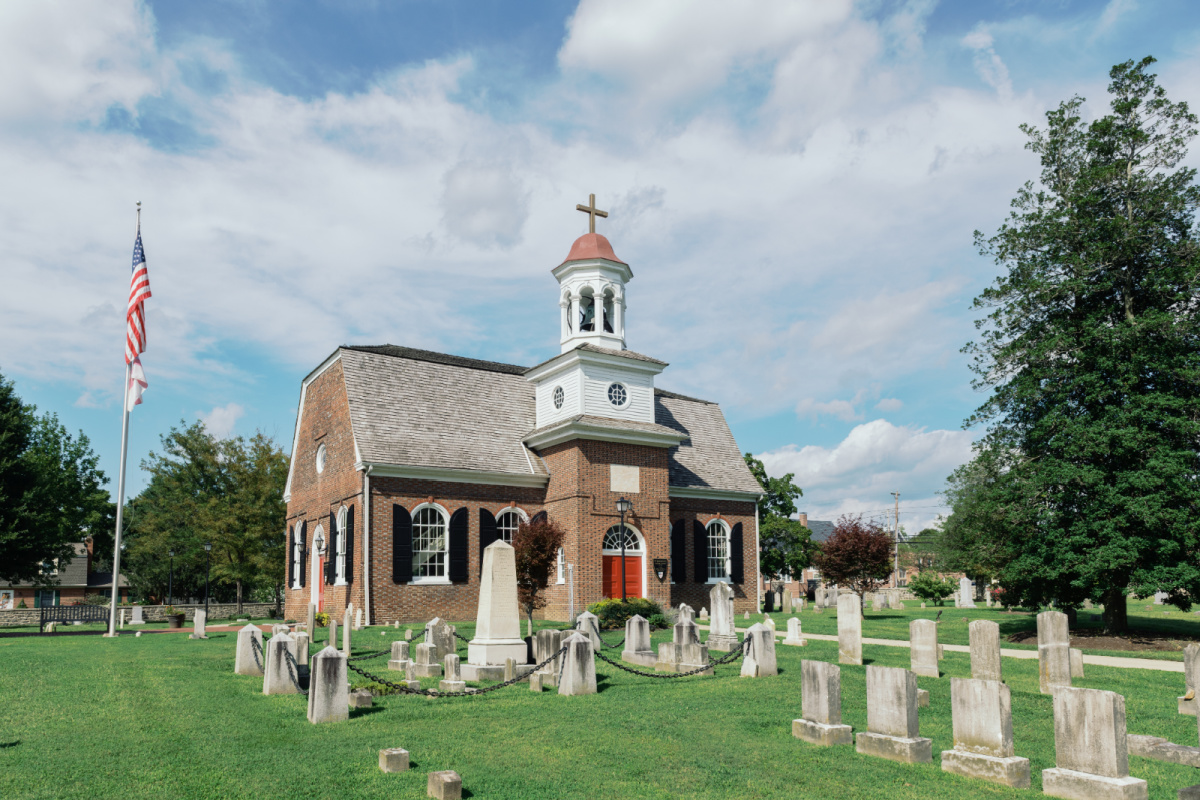
In 1743, the Vestry contracted with Henry Baker to build a brick church for 300 pounds to replace the old wooden structure. A detailed description of this building can be found in the minutes of the Vestry dated March 1, 1743, except for the bell tower, which was added later.
The cornerstone at the southwest corner of the building contains the initials of the rector and Vestry members of the time, along with the date 1743. The names are: The Reverend William Wye (rector), John Currer, Zebulon Hollingsworth, Nicholas Hyland, Henry Baker, Edward Johnson, and Thomas Ricketts.
The church building’s architecture is typical of mid-eighteenth-century colonial America, but the combined gambrel and hip roof is unusual. The walls are 3-4 bricks thick and, on the south side, laid in the Flemish Bond style with dark accents.
The Vestry’s early responsibilities
During this period, the Vestry held several interesting responsibilities, including:
- Holding the glebe land in trust. The parish received a large parcel of property known as glebe land. (Glebe land is a parcel of land assigned to a parish church or clergyman to provide food or financial support.) A farmer worked this land, about 100 acres near Charlestown, to provide funds to support the minister.
- Helping raise additional funds through taxes on local landowners.
- Addressing matters of morality in the community, especially “illegal cohabitation.”
The Revolutionary War
The first mention of the War for American Independence appeared in the Vestry minutes in September 1777 when, following the landing of Howe’s troops on the shore of the Elk River on their way to capture Philadelphia, the minutes stated:
“The English appear’s in our Rivers and Bays and our Vestry thereby being disturbed could not meet and therefore cannot be accountable for any Fines imposed”.
The next year, the Rector, the Rev. William Thompson, left suddenly and without explanation. Perhaps he left the colonies for England or Canada, as many Anglican clergy did, because they could not swear the Oath of Allegiance to the revolutionary cause (and against the King) without, they believed, violating their vows of ordination.
The Coudons
For the next years, the church lacked a rector, and lay readers led services. The most notable of these was Mr. Joseph Coudon. The Vestry urged him to seek ordination, and in May 1787, Coudon became the first priest ordained in America by Bishop White of Pennsylvania. He served as rector until his death in 1792. A monument to the Rev. Mr. Coudon stands in the chancel of the church.
The 19th Century
In the first part of the 19th century, St. Mary Anne’s fortunes followed an up-and-down path. The church was often without a rector, and records show the property in disrepair.
In times past, stores, a house, a saloon, and even (it is said) a brothel occupied part of the land which is now the churchyard. Vestry minutes record that it was the official duty of the rector to go into the saloon no later than 10 o’clock on Saturday evening to clear out all those who “partook of too much of the evil beverages”. This duty is no longer required of the rector!
By the last half of the century, the Church stood on a much more solid footing. This was likely due to the long-term service of two Civil War veterans. The Rev. Enoch K. Miller, a Union Chaplain, was the rector for seventeen years. He was succeeded by the last surviving member of General Robert E. Lee’s staff, the Rev. Giles B. Cooke.
Church building updates
The original small-pane windows were replaced in the last century, as were the shutters, the old stall pews, and most of the remaining interior. Recently, the shutters were restored to their original style, but the interior furniture and design are entirely Victorian or modern.
The bell tower was built in 1904 by the Brookings family in memory of Robert S. Brookings, founder of the Brookings Institute in Washington, D.C. The tower replaced an earlier wooden structure at the west door.
The churchyard
The churchyard has many old, interesting tombstones, though time has made some inscriptions illegible.
- The small stones behind the Vestry House are thought to mark the graves of Native Americans.
- Jeremiah Baker, who fought in the Revolution with Washington at Monmouth, is buried near the Vestry House.
- Many stones mark the Coudon family, which has been active in the parish to the present time. In fact, on September 28, 2008, Joseph Couden IX was baptized at the 10:30 service!
The Thompson Memorial Crocus Lawn was planted with 10,000 crocus bulbs in honor of beloved parishioner, Diane Thompson, who started the Garden Market. The bulbs remind us of Diane, the Garden Market, and the yearly promise of Resurrection.
St. Mary Anne’s other church buildings
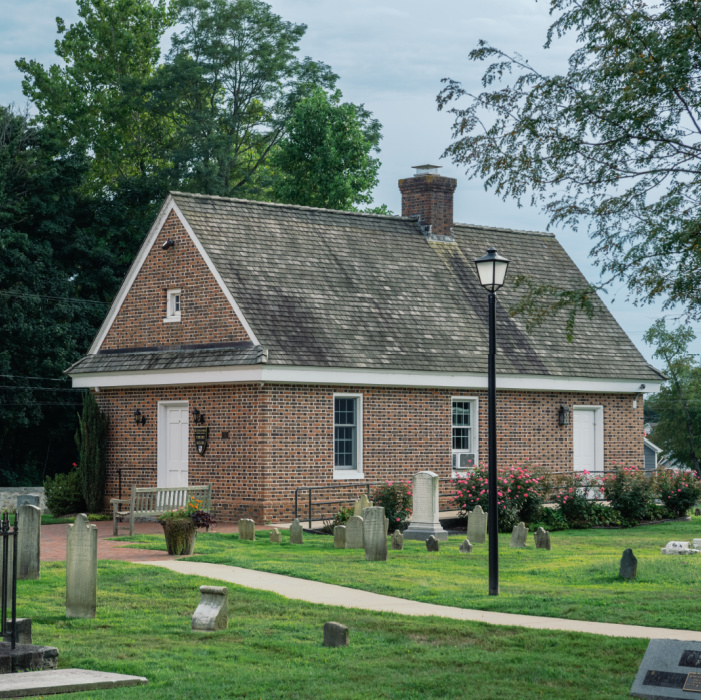
The Vestry House, historically where the colonial vestries carried out their civil and church duties, is of recent construction but patterned after similar original colonial buildings at other parishes.
Other parish buildings include the old sexton’s house, across Church Point Road, and the parish house and rectory, of modern construction, adjacent to the churchyard to the north.